|
We
recognise Anton Pavlovich Chekhov as one of the greatest poets, dramatists and
writers. His tragedies were particularly renowned. But as it happened, Chekhov’s
favourites were French farces and vaudevilles or light comical theatrical pieces
that combined pantomime, dialogue, song and dance. He has produced some great
one-act plays too.
|
Like
the other all-time literary greats, William Somerset Maugham and A. J. Cronin,
Chekhov too was a qualified medical doctor who showed a distinct leaning for
writing stories and plays rather than writing prescriptions for patients.
Chekhov
was born in Taganrog, Russia, on the Sea of Azov, on January 29, 1860.
Chekhov’s romance with writing began during his days as a medical student at
the University of Moscow, when he began to spin weaves of fantasy with his pen,
churning short stories with ease. After qualifying to practise medicine in the
year 1884, Chekhov took to the pen seriously. He began as a freelance journalist
and as a writer of comic sketches.
|
 |
|
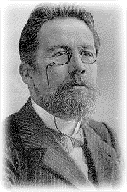
Anton Pavlovich Chekhov |
| Soon
after, Chekhov mastered the art of one-act plays and soon produced some
masterpieces. Some of these include The
Bear, produced in the year 1888 and The
Wedding, produced in 1889. The former deals with a young widow who is
hounded by her creditor. Driven to fancy ends, the young lady agrees to even
face her creditor in a duel! So impressed is the creditor that he proposes
marriage to her. The Wedding is the story of a bridegroom’s earnest desire to have
a general attend his wedding ceremony and who later discovers that the special
invitee is a retired naval captain "of the second rank".
|
Chekhov's
first full-length plays, Ivanov (1887)
and The Wood Demon (1888) did nothing to plant him firmly in the
literary field. What really catapulted him to success was the production of his
plays by the Moscow Art Theatre. It began with his The Seagull (1897), a play that had been received so badly when
produced earlier by a different company two years earlier that Chekhov had
walked out during the second act. Chekhov now plunged into a critical analysis
of his plays and presented the Moscow Art Theatre a revised version of The
Wood Demon, renamed Uncle Vanya,
in the year 1899. Along with his later productions The
Three Sisters and The Cherry Orchard,
Uncle Vanya went on to become one of
the masterpieces of the modern theatre.
In
spite of the success and fame that descended on the duo (Chekhov and the Moscow
Art Theatre director Constantin Stanislavsky), Chekhov was unhappy with the way
the director was handling his plays. While Chekhov considered his mature plays
to be a kind of comic satire, he felt that Stanislavsky laid too much emphasis
on the tragic elements in the play. Whatever their disagreements, as a team
their production won great acclaim. About himself, Chekhov has said that he
merely wanted to communicate to his people that they should look at themselves
and realise the dreariness of their lives. He believed that once people did that
they would create a better life for themselves.
Chekhov
contacted lung haemorrhage at the very early age of thirty-seven. As the disease
advanced, he was forced into a sort of a retirement in Crimea, although he
continued his visits to Moscow to participate in the production of his plays. He
breathed his last on July 14, 1904, at age forty-four. He was buried in Moscow,
but has remained immortal through his stories, poems and plays.
|
